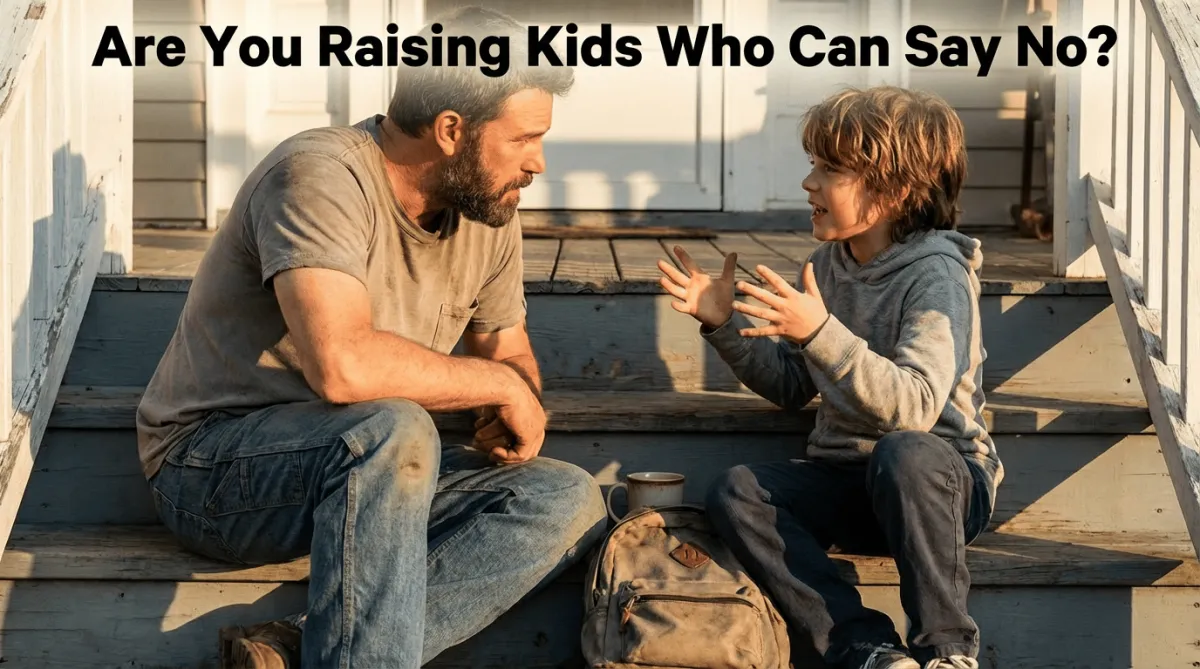
Because I Said So
What that four-word phrase is teaching your kids, and what it costs some of them everything.
Are You Raising Kids Who Can Say No?
Count how many times you said "because I said so" this week.
Go ahead. Actually, think about it.
Maybe it was bedtime. Maybe it was screen time. Maybe it was when your kid asked why they had to apologize to their sibling, even though, in their mind, their sibling started it. You were tired. You didn't have the bandwidth for a negotiation. So you pulled rank and moved on.
We've all been there. I'm not here to drag you for it.
But I want to sit with that phrase for a second, because I read something this week that I haven't been able to stop thinking about, and I think every dad in this group needs to read it too.
It's a piece called "Because He Said So" by Montessori Miss Emily over on Substack. On the surface, it's about the Epstein files and how a classroom culture built on compliance may have conditioned the girls he targeted to override their own instincts. That sounds like a lot, and it is. But underneath that, it's really asking one question that hits different when you're a dad:
Are we raising kids who know they're allowed to say no?
Go read it. The link is at the bottom. Read the whole thing. Come back.
The Thing We Don't Talk About
Most of us grew up in households where authority was the final word. Dad said it, that was it. The teacher said it, that was it. Coach said it, you ran another lap. And a lot of us didn't turn out too badly, so we don't question the model. We just inherited it and started running it on our own kids without ever stopping to ask whether it was actually working the way we thought it was.
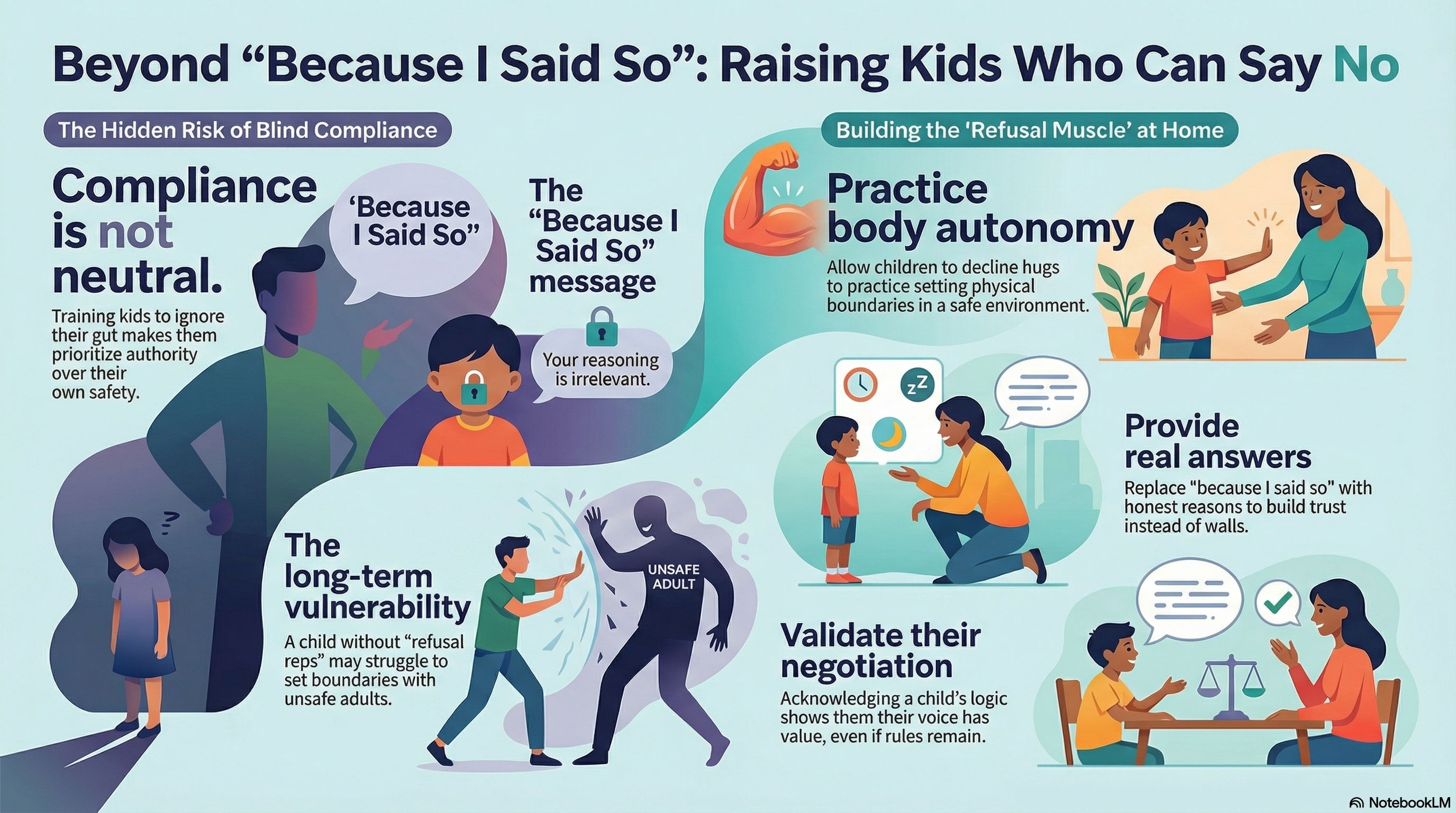
Here's what the article made me think about: compliance isn't neutral. Every time a kid is trained to go along without understanding why, they get a little more practiced at overriding themselves. At swallowing the feeling in their gut. At deciding that their discomfort is less important than the authority figure in the room.
That's not always wrong. There are moments where kids need to listen and move, and explaining everything in real time isn't realistic. Nobody's arguing that.
But there's a difference between teaching kids to respect authority and training them to never question it. And most of us, if we're honest, have been doing more of the second than we realize.
What Your Kid Is Actually Learning
Kids are watching everything. Not what we say. What we do, and more importantly, how we respond when they push back.
When your kid questions a rule, and you shut it down with "because I said so," you're not just ending an argument. You're sending a message. The message is: your questions don't matter here. Your reasoning is irrelevant. The person with power doesn't owe you an explanation.
Now play that out over the years. Hundreds of small interactions. Thousands of moments where a kid learns that the right move is to go quiet, nod, and comply.
What happens when that kid is fourteen and a coach asks them to stay after practice alone?
What happens when that kid is sixteen and a teacher makes them uncomfortable, and they don't say anything because they've never practiced saying anything?
What happens when that kid is nineteen, and someone older and more powerful puts them in a situation they didn't consent to, and the muscle they'd need to push back has never once been exercised?
I'm not trying to scare you. I'm trying to wake us both up.
This Isn't About Raising Soft Kids
Let me be clear about something because I know how this can land.
Teaching your kid to question authority is not the same as raising a kid who has no respect for it. Those are two completely different things, and confusing them is part of why we end up with either doormat kids or out-of-control kids, with no middle ground.
The goal isn't a kid who argues about everything. The goal is a kid who has enough of a relationship with their own gut that they trust it when something feels wrong. A kid who has enough practice saying "I don't want to" in small, safe moments so that they can find those words in a big, unsafe one.
That takes reps. And those reps happen at home, with you, in the everyday friction of family life.
Let your kid negotiate sometimes. Not always. But sometimes. Let them make the case for why the rule is unfair. Hear them out. Maybe you hold the line anyway, but you explain why. You show them that authority can be questioned and that the world doesn't fall apart when it is. You show them that their voice has value even when the answer is still no.
That's not a weakness. That's raising a kid with a spine. And that's one of the most important things a dad can do.
The Part That's Uncomfortable for Us
Here's where it gets personal.
A lot of us are carrying our own history with authority. Maybe you had a dad who ruled with an iron fist, and you swore you'd be different. Maybe you had a dad who was so checked out that you're now overcorrecting by being too controlling, because at least that means you're present. Maybe you never had a dad at all, and you're making the whole thing up as you go, which, honestly, is most of us more than we admit.
The point is, the way we handle authority with our kids is rarely just about parenting strategy. It's wrapped up in our own stuff. Our own conditioning. Our own unexamined patterns, inherited without ever being asked whether we wanted them.
"Because I said so" might have been the only language modeled for you. And if that's the case, it's going to feel completely natural to reach for it. It's the tool in the toolbox you know how to use.
But knowing where a habit comes from is the first step to deciding whether you want to keep it.
What Miss Emily Gets Right
The piece doesn't let institutions off the hook either, and I think that matters. It connects the compliance culture in schools to the culture that made places like Harvard protect Jeffrey Epstein even after his conviction. That's a heavy line to draw, but she draws it carefully, and it lands.
The argument isn't that teachers are predators. The argument is that a system designed to produce obedient, non-questioning children is perfectly suited to predators. They didn't build that system. They just know how to use it.
And that's something worth sitting with as dads, because we are also a system. The family is a system. And the question is whether our system produces kids who trust their instincts or kids who have learned to mute them.
Montessori's framing of children as "forgotten citizens" is one I keep coming back to. Citizens have rights. They can question. They can push back. They have standing. Most kids have none of that. And we think that's just how childhood works because that's how our childhoods worked.
But it doesn't have to be that way. And as dads, we have more power to change it than anyone.
A Few Things Worth Trying
This isn't a seven-step program. But if this landed for you at all, here are some small things worth experimenting with this week.
The next time your kid asks why, answer them. Even if it's a hassle. Even if the answer is "honestly, just because I'm tired and I need you to listen right now." That's a real answer. Kids can handle real answers. What they can't do is build trust with a wall.
The next time your kid says they don't want a hug, let them not have the hug. Their body, their call. Practice that with the people who love them, so it's a reflex with everyone else.
The next time your kid pushes back on something and actually makes a decent point, tell them. You don't have to change the rule. Just acknowledge the point. "You know what, that's fair. I hear you. The answer is still no, but that was a good argument." Watch what that does to them.
None of this is complicated. All of it takes more energy than "because I said so." But the payoff is a kid who knows their voice matters, knows their body belongs to them, and knows that when something feels wrong, they are allowed to say so out loud.
That's the kid you want in the world. And you're the one who builds them.
Go Read It
Seriously. Block fifteen minutes. Put the phone face up on the table for once and actually read this one.
"Because He Said So" by Montessori Miss Emily: https://montessorimissemily.substack.com/p/because-he-said-so
It's not a comfortable read. It's not supposed to be. But it's one of the more important things I've come across in a while, and I think it'll hit differently when you read it as a dad who's thinking about what he's actually teaching his kids every single day.
We're out here trying to raise good humans. That starts with asking better questions of ourselves.
No lectures. Just life.
One More Thing
If you're a man reading this and something resonated, I want to hear from you.
Not about whether you agree with the article. Not about sports or the weather or what's happening in the news. About the real stuff.
What are you hiding? What are you afraid to say out loud? What construct in your life, whether that's your job, your religion, your social circle, or a family expectation you never signed up for, is keeping you from showing up as the man you actually want to be?
Because here's the thing. We talk a lot about raising kids who can say no, question authority, and trust their gut. But a lot of us never learned that ourselves. A lot of us are still walking around, complying with a version of our lives that somebody else designed for us, and we've never once stopped to ask whether we actually want it.
That's worth a conversation.
Not a therapy session. Not a lecture. Just two guys talking about the hard stuff, the way men should be able to talk about it, but rarely do.
Reach out. [email protected]
Let's build something real.